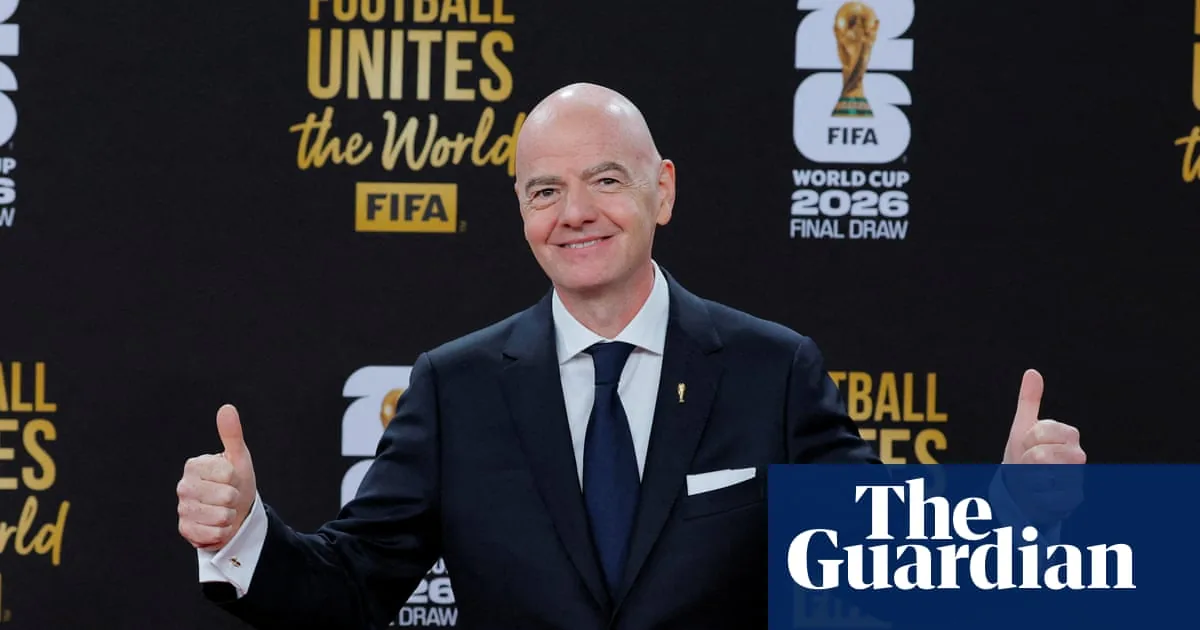

European football bodies react to FIFA proposals
UEFA, European football’s governing body, has stated that it and its national associations will not participate in FIFA competitions if a proposed funding deal is accepted. This declaration, made on Thursday, 30 July, is a direct response to FIFA President Gianni Infantino’s plan to sell a 20% stake in a subsidiary company. This new company would manage FIFA’s competitions, including the World Cup, and would be partly funded by private investors, one of whom is the brother of US President Donald Trump’s son-in-law, Joshua Kushner.
The proposed deal has also been rejected by Concacaf, the governing body for football in North and Central America, whose 41 members voted against the proposals. The Football Association (FA) chair, Debbie Hewitt, a FIFA vice-president, has spoken out against the plan, with the FA stating it stands “shoulder to shoulder with our European colleagues.” Similarly, the Scottish FA, whose president Mike Mulraney chairs FIFA’s finance committee, has expressed unequivocal agreement with UEFA’s stance.
A 25-page document titled “Fifa Forward Enterprise Member Materials” outlines the case for creating a new company to manage FIFA’s commercial operations. This document, produced by JP Morgan, suggests that financial growth would come from an expanded tournament portfolio, third-party capital, debt financing, and prioritizing high-yield partnerships and events. It also refers to potentially more than doubling the number of global tournaments held annually, from 200 to 450.
Implications for tournaments and leadership
The boycott threat from UEFA could impact upcoming tournaments. A senior European football source noted the potential for European nations to withdraw from the U20 Women’s World Cup, which begins on 5 September in Poland and features several European teams. The deadline for countries to accept FIFA’s deal and receive a $20m payment is 19 September. Following this, the next senior FIFA competitions are the Women’s World Cup play-offs in October, which include teams like England, Scotland, Wales, and Northern Ireland.
Laura McAllister, UEFA vice-president and former Wales international, stated that Wales is involved in the play-offs for the Women’s World Cup, and qualifying would mark their first participation in a World Cup. She emphasised that UEFA views the situation as a problem created by FIFA, not by UEFA, and that nobody wants players or nations to suffer in prestigious competitions.
The controversy has also raised questions about Gianni Infantino’s future as FIFA president. He became president in 2016 and is scheduled to stand for a fourth term in March. While it was previously anticipated he would be re-elected unopposed, sources indicate that a significant majority of Concacaf members are losing faith in his ability to govern. There is now discussion about finding a candidate to challenge him, with Nasser Al-Khelaifi, president of Paris St-Germain and leader of European Football Clubs, being mentioned, though sources close to him suggest he is not interested in the role.
Financial aspects and lack of consultation
The sales deck from JP Morgan suggests that FIFA is “undermonetized” and compares its annual revenue of $3.6bn unfavourably with other sports leagues like the NFL’s $21.2bn, Major League Baseball’s $13.1bn, and the NBA’s $12.5bn. However, critics have questioned these comparisons, noting that FIFA is a world governing body, not a private, member-run league. Concerns have also been raised about FIFA’s need to take on debt, given its cash reserves of approximately $4bn and accumulated revenues of $15bn over the current four-year cycle.
A notable omission in the 25-page document is any mention of women’s football. The lack of proper consultation and dialogue from Infantino regarding these proposals has generated anger among many, including his FIFA colleagues. David Bernstein, former FA chairman, believes a solution must be found, stating that a schism would be a “lose-lose for everybody,” as FIFA cannot afford to exclude European nations, and Europe cannot afford to be excluded from FIFA competitions. The document indicates that investors will gain access to a term sheet and select materials in August, before a vote by FIFA members.
The statement from UEFA arrived at 16:00 BST on Thursday, 30 July.
Source: bbc.co.uk

Daniel Fairbrother is the Senior Football Correspondent at Latest News UK, covering the Premier League, the EFL and the England national side with over a decade of reporting experience. He spent eight years on the football desk of a Yorkshire daily before moving into national coverage. He holds a degree in Sports Journalism from the University of Sunderland and completed an NCTJ diploma. Based in Leeds, he watches non-league football and runs a five-a-side league. “The best football stories are won in the week, not on the whistle.”