
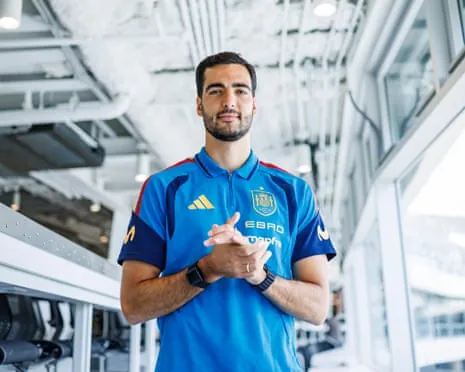
Spain midfielder Mikel Merino has reflected on a significant year in his career, marked by personal milestones and a return from injury, as his national team prepares for the World Cup final against Argentina. Merino, who recently became a father, described the year as “spectacular” despite facing a stress fracture in his foot that threatened his participation in the tournament.
The 30-year-old underwent surgery at the end of January and spent two months on crutches. He admitted that he did not believe he would make it to the World Cup following the injury. His recovery involved dedicated work, supported by his wife during her pregnancy. Merino played only 28 minutes between January and the start of the World Cup, leaving his newborn son, Marco, to join the squad.
Merino has proven to be a crucial player for Spain from the bench. He scored a goal in the 119th minute against Germany in the Euro 2024 semi-finals, securing Spain’s place in the final. During the current World Cup, he scored a 91st-minute goal against Portugal in the last 16 and another against Belgium in Los Angeles, just 1 minute and 55 seconds after coming on as a substitute. His goals have been celebrated in a manner reminiscent of his father, Ángel Miguel, who scored late for Osasuna 33 years prior in the same Stuttgart stadium.
Team Cohesion and Philosophy
Merino emphasised the importance of team unity and the philosophy instilled by coach Luis de la Fuente. He noted that while coming off the bench is not ideal for any player, the strength of the national team encourages valuing every opportunity to contribute. He believes in his ability to make an impact whenever he enters the pitch.
The midfielder highlighted the balance between ego and humility required in football. He explained that players arriving at the national team from important roles at their clubs often encounter a new dynamic. Merino credits De la Fuente and the squad for fostering an environment where being a “good human” is prioritised before being a “good footballer,” which aids in spending extended periods together.
Many members of the current squad have played under De la Fuente at junior levels, including Merino and Rodri, who were part of the European Under-19s winning team in 2015. This long-standing relationship has built a strong foundation of trust and understanding within the team. De la Fuente’s tenure began with a loss to Scotland, but since then, Spain has lost only once in 37 games, a defeat on penalties in the Nations League final. They have since won a Nations League title and a Euros.
Tactical Approach in the Final
Spain will face Argentina in the World Cup final at MetLife Stadium in New Jersey. Their tactical approach, particularly the use of geometric formations, has been noted as a key element of their success. In their 2-0 World Cup semi-final victory over France, Spain frequently formed passing triangles, which created options and disrupted the opposition’s defence.
This strategy involves players positioning themselves at different angles to the ball carrier, forcing defenders to make choices about which passing lanes to cover. The effectiveness of these triangles lies in their ability to adapt to the changing positions of defenders, ball speed, and available space. Spain’s ability to quickly reconfigure these formations made it difficult for France to reorganise their defence.
The concept of using triangles in sports is not new; the Chicago Bulls under coach Phil Jackson employed a similar “triangle offence” in basketball. The principle is to preserve alternatives, ensuring that if one route is closed, another remains open. Pedro Porro’s goal in the semi-final, following an exchange of passes with Dani Olmo, demonstrated how shifting defenders’ focus and creating new angles can lead to scoring opportunities. The final match is anticipated to feature a prominent role for geometry in Spain’s play.

The team’s collective strength and belief have been central to their journey to the final. Merino noted that the group is very strong, despite the extended time spent together. He anticipates that some teammates may even plan to go away together after the World Cup, which he finds impressive.
Spain’s preparations for the final include a focus on normalising the occasion, treating it as another game to be enjoyed. The team’s routine no longer includes the chocolate and cakes that were part of past rituals, with nutritionists having removed them. The squad engages in various activities, such as playing PlayStation, Mario Kart, or chess, and some, like Merino, prefer long conversations after meals, discussing life and future plans.
The team’s unity is built on respect and a shared history, with De la Fuente having coached many of the players since their youth. This deep understanding allows the coach to have full faith in his players, knowing they will give their all for him. The team’s journey to the final has been described as a testament to their belief and resilience.
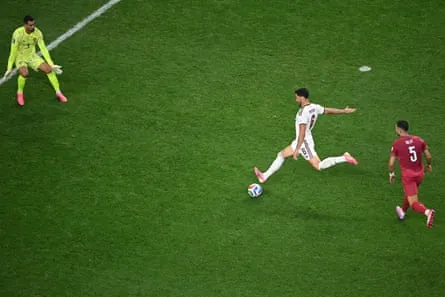
The upcoming World Cup final will see Spain aiming to secure the trophy, with Merino hoping that any Spanish player can be the hero, as he believes the trophy belongs to the entire team, not just the 11 players on the pitch.
Read Also
Source: theguardian.com

Leo Ashworth is a Sports News Writer at Latest News UK. He cut his teeth on regional sport before specialising in fast breaking-news writing. He focuses on rugby union, golf and boxing and is known for clear, deadline-driven reporting. He holds a degree in Journalism from the University of Central Lancashire and completed an NCTJ diploma. Now based in Newcastle, he follows the European Tour and boxes at an amateur gym. “Get it right first, then tell readers why it matters.”